
Bhadrakali
She is a fierce form of Shakti or Kali herself worshipped in various forms. She is mostly depicted with three eyes, protruding tusk, multiple hands, and flames emerging from her head. Some of her icons in South Indian temples portray her motherly nature while others as a fierce deity.
-
Dakshajit: As the consort of Virabhadra, a fearsome form of Shiva. She sprung from the anger of Shakti, who accomplished Virabhadra to destroy the sacrifice of Daksha, hence called Dakshajit. She is mostly worshipped in South India as a guardian deity. She is depicted with three eyes, and four to eighteen hands, carrying various weapons. Unlike other forms of Kali, she is not shown standing on Shiva. She is also called Rudrakali, which means the one who roars.
-
Darikajit: In Kerala, Bhadrakali is also known as Darikajit, the slayer of Darika, a demon. She is depicted mounted on a betal (ghost or ghoul) and slaying Darika.
-
Rurujit: According to the Varaha Purana, she is a form of Parvati or Bhadrakali who slayed the demon Ruru. Ruru wanted to marry Parvati but she arrived in a horrific form to him and slayed him. Rurujit is described as wearing the lion’s hide and hair smeared with the blood of a lion.
-
Mahishajit: According to Kalika Purana, Bhadrakali appeared during the Treta Yuga to defeat Mahishasuras. This form is revered as Mahishajit.

Chaturbhujā Pratyangirā
A powerful and unyielding expression of Goddess Kāli, Saṁhāra Kāli is linked to destruction, retreat, and the dissolution of existence. She is regarded as a force that transcends domestic devotion or goodwill.
Saṁhāra Kāli is portrayed iconographically as having four limbs, a dark skin, and a fearful, enraged face. Typically, she is depicted with one hand in varada mudrā, holding a skull bowl (kapāla), chopped skulls, and a khadga (sword). She emphasises her active role in cosmic dissolution by placing her left foot on top of Śiva's recumbent body. Her wild and intimidating appearance is frequently complemented by unkempt hair and links with cremation grounds.

Ṣoḍaśabhujā Pratyangirā
Krodhakālī is a wrathful form of Vajravārāhī within Buddhist Vajrayāna, expressing the most forceful aspect of Vajrayoginī’s awakened energy. She embodies enlightened wrath, where fierce appearance serves immediate clarity rather than destruction. Krodhakālī is depicted in dark blue or black hues, with a terrifying yet lucid expression, emphasizing uncompromising wisdom. She stands in a dynamic, trampling posture, subduing forces of ignorance and obstruction, and holds the curved knife (kartṛkā) and skull cup (kapāla). Adorned with bone ornaments and a garland of skulls, she functions as a completion-stage deity, arising when obstacles must be severed instantly.

Daśabhujā Pañcamukhī Pratyangirā
Associated with the Aghora tradition, which addresses death, impurity, and terror as direct routes to realisation, Aghor Kāli is a powerful and rebellious manifestation of Goddess Kāli. The paradoxical meaning of aghora, which translates to "that which is not terrifying," embodies the central lesson of this form: nothing is outside the Goddess and nothing should be rejected. Aghor Kāli is a living example of the fact that freedom transcends dualities, societal conventions, and conditioned ideas of impurity and purity.
Aghor Kāli appears frightful and wild, and is portrayed as being coated in ash or darkness. She is frequently depicted with a trident, a garland of skulls, and unkempt hair, either nude or sparsely dressed. Her imagery is intentionally disturbing, confronting, and unvarnished.
Atharvaṇa Bhadrakālī
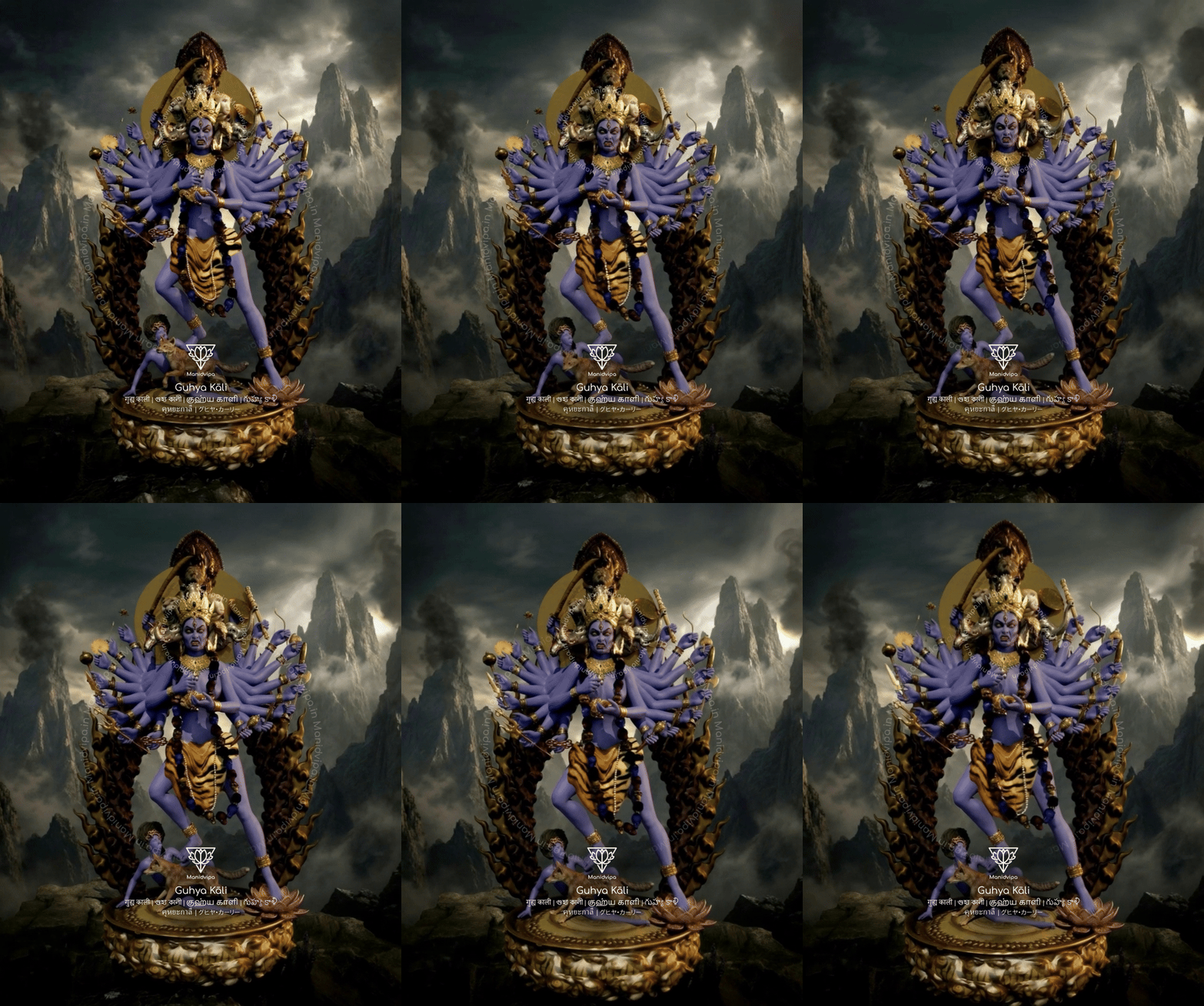
Guhya Kāli, which translates to "the Secret One," is considered to be one of the most obscure and supreme manifestations of Goddess Kāli. She is said to represent the entirety of cosmic functions inside herself and to be the force that creates, maintains, and dissolves the cosmos. Guhya Kāli is a member of esoteric Tantric traditions, where her knowledge is maintained by initiation, seclusion, and profound contemplation, in contrast to more widely worshipped incarnations.
Her iconography is very different from other Kāli forms. As a symbol of her all-encompassing nature, Guhya Kāli is said to have hundreds of faces. She possesses twenty-seven eyes in her famous ten-faced form, with some faces having three eyes and others having two. A leopard, lion, jackal, monkey, bear, crocodile, elephant, or horse are just a few examples of the various animals that each face might represent. The faces of these animals also vary in colour. This variety of faces and hues highlights her limitless and multifaceted character, which transcends a particular identity or form.


Atharvana Bhadrakali
The strong and esoteric manifestation of the Divine Mother known as Atharvaṇa Bhadrakālī is connected to the Atharva Veda, a collection of sacred knowledge that deals with healing, protection, and neutralising invisible forces. She stands for the strong, defensive side of Shakti that functions outside of the material realm, neutralising evil forces, eliminating malicious intent, and re-establishing harmony.
Pratyangira is regarded in many traditions as Atharvaṇa Bhadrakālī's most popular and approachable manifestation. She invokes and experiences the deeper currents of Atharvanic strength, including spiritual defence, occult protection, and mantric energy. Nonetheless, Pratyangira is also recognised as a separate divinity with unique beginnings in several regional and folk traditions, illustrating how these powerful feminine forces change throughout various cultural contexts.
Chaturbhujā Pratyangirā
A powerful and unyielding expression of Goddess Kāli, Saṁhāra Kāli is linked to destruction, retreat, and the dissolution of existence. She is regarded as a force that transcends domestic devotion or goodwill.
Saṁhāra Kāli is portrayed iconographically as having four limbs, a dark skin, and a fearful, enraged face. Typically, she is depicted with one hand in varada mudrā, holding a skull bowl (kapāla), chopped skulls, and a khadga (sword). She emphasises her active role in cosmic dissolution by placing her left foot on top of Śiva's recumbent body. Her wild and intimidating appearance is frequently complemented by unkempt hair and links with cremation grounds.
Ṣoḍaśabhujā Pratyangirā
Krodhakālī is a wrathful form of Vajravārāhī within Buddhist Vajrayāna, expressing the most forceful aspect of Vajrayoginī’s awakened energy. She embodies enlightened wrath, where fierce appearance serves immediate clarity rather than destruction. Krodhakālī is depicted in dark blue or black hues, with a terrifying yet lucid expression, emphasizing uncompromising wisdom. She stands in a dynamic, trampling posture, subduing forces of ignorance and obstruction, and holds the curved knife (kartṛkā) and skull cup (kapāla). Adorned with bone ornaments and a garland of skulls, she functions as a completion-stage deity, arising when obstacles must be severed instantly.
Daśabhujā Pañcamukhī Pratyangirā
Associated with the Aghora tradition, which addresses death, impurity, and terror as direct routes to realisation, Aghor Kāli is a powerful and rebellious manifestation of Goddess Kāli. The paradoxical meaning of aghora, which translates to "that which is not terrifying," embodies the central lesson of this form: nothing is outside the Goddess and nothing should be rejected. Aghor Kāli is a living example of the fact that freedom transcends dualities, societal conventions, and conditioned ideas of impurity and purity.
Aghor Kāli appears frightful and wild, and is portrayed as being coated in ash or darkness. She is frequently depicted with a trident, a garland of skulls, and unkempt hair, either nude or sparsely dressed. Her imagery is intentionally disturbing, confronting, and unvarnished.
Atharvaṇa Bhadrakālī
Guhya Kāli, which translates to "the Secret One," is considered to be one of the most obscure and supreme manifestations of Goddess Kāli. She is said to represent the entirety of cosmic functions inside herself and to be the force that creates, maintains, and dissolves the cosmos. Guhya Kāli is a member of esoteric Tantric traditions, where her knowledge is maintained by initiation, seclusion, and profound contemplation, in contrast to more widely worshipped incarnations.
Her iconography is very different from other Kāli forms. As a symbol of her all-encompassing nature, Guhya Kāli is said to have hundreds of faces. She possesses twenty-seven eyes in her famous ten-faced form, with some faces having three eyes and others having two. A leopard, lion, jackal, monkey, bear, crocodile, elephant, or horse are just a few examples of the various animals that each face might represent. The faces of these animals also vary in colour. This variety of faces and hues highlights her limitless and multifaceted character, which transcends a particular identity or form.